



 Back to Insights
From Clutter To Clarity Part 1: The Old Way
I remember standing in a sales centre in Brisbane in the 1990s, looking around a room where every wall was full. Overlapping posters, outdated price lists, three different masterplans, lifestyle shots, aerial photography, and a hand-written “Updated” sticker slapped over yesterday’s numbers. The team behind the project were smart and well-intentioned, they wanted every question answered and every fact available. But from a customer’s point of view, it was hard to know where to look, let alone where to start.
That sales centre wasn’t unusual. It was the industry standard, and it’s where the idea for a very different approach to sales centre design first started to take shape.
How the traditional sales centre formula worked
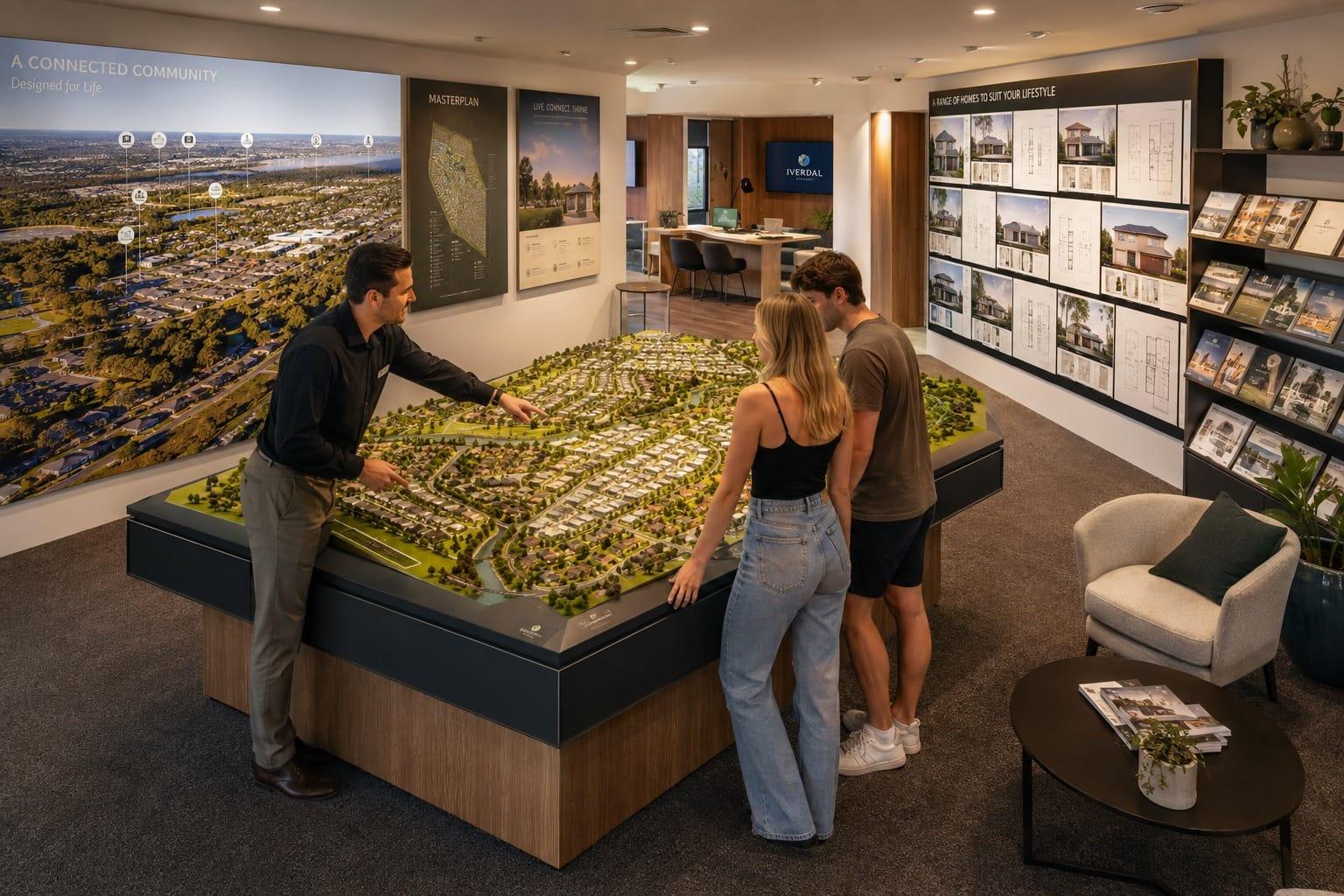
For decades, a property sales centre followed a familiar formula: a large physical model of the masterplan on a plinth, walls covered in photographic panels, maps and information boards, and racks of brochures filling every available space. Flags and temporary signage competed for attention outside.
For many years, this approach worked. The model helped people understand scale. The wall panels explained the vision. The brochures let buyers take information home. For a time, more collateral and more display material were seen as signs of a serious, well-resourced project.
When “more” started to feel like less
By the late 1990s and early 2000s, desktop publishing had transformed how marketing material was produced. It became faster, easier and cheaper to create more of everything, so sales centres responded the only way they knew how: more panels, more brochures, more maps, more “must-include” information.
Large-scale models were still impressive, but expensive to maintain and almost impossible to keep current. Every time a stage sold out, a road alignment shifted or a new park was added, the model and its surrounding information had to be updated. Wall displays kept growing to accommodate new content. Information that started out feeling helpful gradually became overwhelming, and many sales environments moved from places of clarity to places of clutter.
Information without experience
The old model was built on a simple assumption: give people enough information and they’ll eventually feel confident enough to buy. So we focused on facts, how many lots, how many hectares of open space, how many schools nearby, how many minutes to the CBD. We talked road connections, zoning, lot sizes, covenants and construction timelines.
Those tools were excellent at presenting information and far less effective at creating belief. They explained the project but didn’t always bring the place to life. They told people what we were building, not how it would feel to live there. Customers walked out with more paper than they could reasonably read, but not always with more clarity.
When the outside world moved on
By the late 2000s, the world outside the sales centre had changed dramatically. People were researching property online, using smartphones, exploring interactive maps, and arriving already familiar with the basic facts about a development. They expected information to be easy to navigate and tailored to their interests.
Inside many sales centres, we were still relying on the same model-panel-brochure formula, just with more layers added. The gap between how people consumed information in everyday life and how we presented multi-million-dollar communities was widening. Customers wanted clarity, not clutter, to move at their own pace, in their own order, and focus on what mattered to them. It became clear that simply adding more material to the walls was never going to be the answer.
The question that changed everything
That’s when I started asking a different question: what if the sales centre wasn’t built around what we wanted to show, but around how customers actually wanted to discover? Or more simply, what if the customer could explore the project themselves?
At first it felt like a small shift in thinking. But that single idea became the bridge from the old way to the new, and it challenged everything we took for granted about models, wall panels, brochures, and even the role of the sales consultant.
In Part Two, The New Way, I’ll explain how that question led us to rethink the entire sales centre experience, and how it evolved into what is now the SensOreal interactive sales centre platform.