



 Back to Insights
From Clutter To Clarity Part 2: The New Way
The question was simple: what if the customer could explore the project themselves? Answering it took us in an entirely new direction and became the starting point for what is now the SensOreal interactive sales centre platform.
Moving beyond models and static wall displays
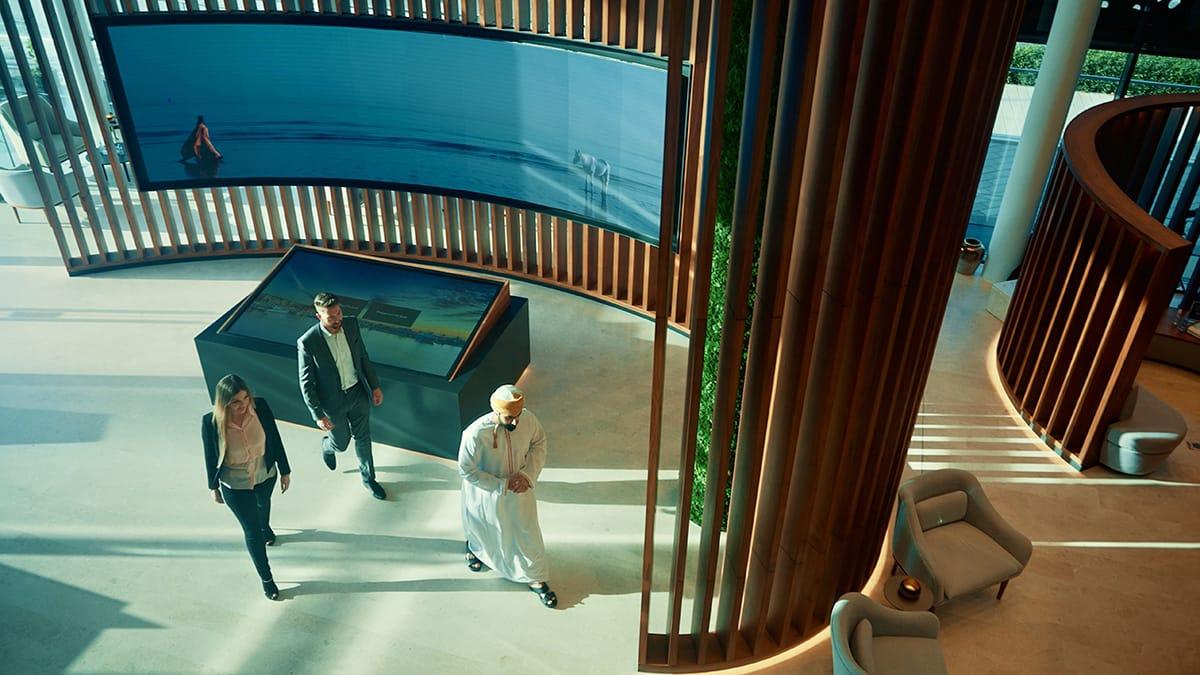
Instead of gathering around a physical model, we began developing an interactive touch screen that presented the masterplan digitally. Customers could discover the project at their own pace, zoom into land releases and explore individual allotments.
The real breakthrough wasn’t the technology, it was the navigation. Rather than building something that behaved like a website where users could easily get lost several layers deep, we developed a simple button-based system that always remained on screen, so customers were free to follow their own interests rather than a scripted presentation.
Select “Education” and a series of options appears e.g. childcare, kindergarten, primary schools, secondary schools, universities. The same approach applies to “Facilities”: parks, shopping, transport, recreation, walking trails. Over time this evolved into a clearer structure, with main menu buttons such as Vision, Discover & Explore, Close to Home and a distinct Now Selling button. Select “Close to Home” and a sub-menu appears with Shopping & Dining, Entertainment, Parks & Recreation, Transport. Each refreshing the screen with maps, key facts, photography and video focused on that one topic.
The amount of information is effectively limitless, yet stays easy to access and just as easy to switch away from with a single touch. Sales consultants have found it invaluable, allowing them to respond naturally to each customer’s questions while visually supporting every part of the conversation.
Technology that improves the conversation, not replaces it
Sales consultants quickly discovered something: the technology wasn’t replacing the conversation, it was improving it. Customers became more engaged because they were exploring topics that genuinely interested them, and the consultant became less of a presenter and more of a trusted guide.
Just as importantly, the cluttered walls began to disappear. Without dozens of display panels, brochures and static information boards, the sales environment itself could finally breathe. Interiors became warmer, calmer and more residential.
From information to immersion
Our next evolution connected the interactive touch screen to a large panoramic display, so every selection was supported by full-screen photography, video and atmospheric imagery across the room. Something unexpected happened: the technology faded into the background. Instead of focusing on screens, people became immersed in the story of the place. The sales centre was no longer presenting information — it was creating an experience. Long before “immersive experiences” became fashionable, we had unknowingly started creating them. That philosophy eventually became SensOreal.
The birth and evolution of SensOreal
Designed, developed and coded entirely by our team in Adelaide, SensOreal now operates across Australia and the Middle East, delivering consistent property marketing experiences twenty-four hours a day, seven days a week. Unlike traditional web-based systems, each installation runs locally, so it keeps functioning even if internet connectivity is interrupted, while intelligent synchronisation quietly refreshes content in the background.
Today, SensOreal Pro extends that same philosophy further. A single source of content can simultaneously drive interactive sales centres, project and corporate websites, conference presentations, and tablets and mobile devices. Prospective purchasers can explore multiple developments, continue their journey from home, or reconnect with a project long after leaving the sales centre. SensOreal is a consistent, intuitive experience available anywhere in the world.
The principle that hasn’t changed
Looking back, it’s remarkable how much has changed over the decades from hand-painted signs, photographic panels and physical scale models to immersive digital environments experienced anywhere, in any language, on almost any device around the globe.
Yet the underlying principle hasn’t changed. People don’t buy information, they buy confidence. Our job has never simply been to present facts. It’s been to remove complexity, tell the story clearly, and create an environment where people can comfortably imagine the next chapter of their lives. Perhaps that’s the biggest lesson from five decades in this industry: less really is more.